
You are here
Baltic Shadow Games: Finland Detains Cargo Ship in Suspected Hybrid Attack
Baltic Shadow Games: Finland Detains Cargo Ship in Suspected Hybrid Attack
Paul Morgan January 2, 2026 https://gcaptain.com/baltic-shadow-games-finland-detains-cargo-ship-in-s...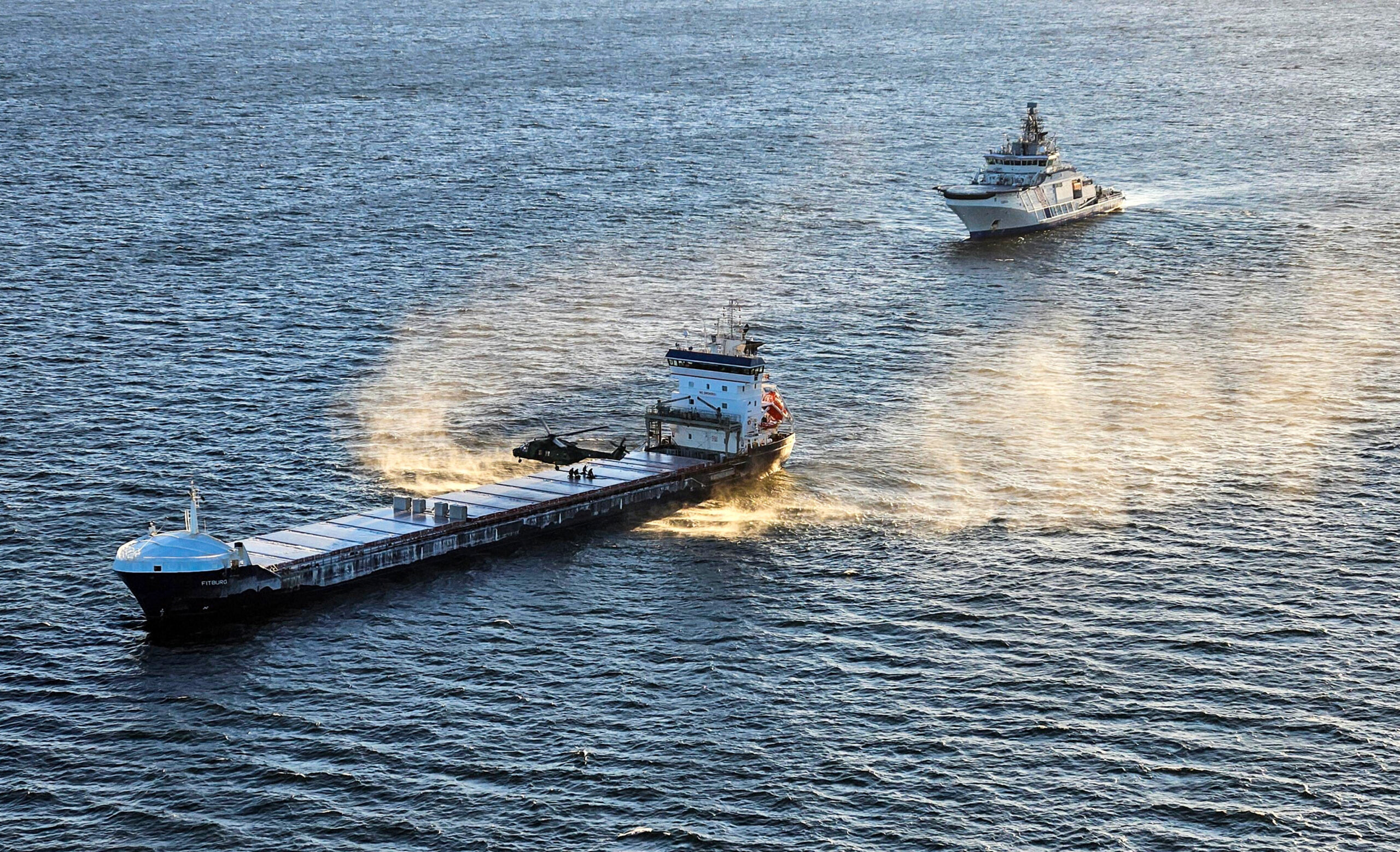
A Border Guard helicopter and a Coast Guard patrol ship Turva seize the Fitburg vessel suspected of a subsea cable breach in the Gulf of Finland on 31 December 2025, in this handout picture obtained on January 1, 2026. Finnish Police/Handout via REUTERS
Finnish commandos seize cargo ship Fitburg after suspected sabotage of Baltic data cable — then uncover a hidden cargo of sanctioned Russian steel.
By Paul Morgan (gCaptain) – When Finnish telecom engineers at Elisa detected a sudden fault in their submarine data cable shortly before 5 a.m. on New Year’s Eve, the disruption initially appeared routine. By evening, Finnish special forces had rappelled from helicopters onto a foreign cargo vessel, detained its multinational crew, and uncovered what authorities now describe as a double violation: suspected sabotage of critical infrastructure and apparent smuggling of sanctioned Russian steel.
The dramatic seizure of the Fitburg has thrust the Baltic Sea back into the spotlight as a frontline in an emerging contest over Europe’s undersea infrastructure, raising urgent questions about maritime security, sanctions enforcement, and the legal complexities of prosecuting such incidents.
The 132-meter general cargo ship, flying the flag of Saint Vincent and the Grenadines, departed St. Petersburg on December 30 bound for Haifa, Israel. Around 04:53 local time on December 31, Elisa reported disruption to one of its telecommunications cables between Helsinki and Tallinn, with the damage located in Estonia’s exclusive economic zone. Finnish Border Guard vessel Turva and a helicopter were dispatched to investigate.
What they discovered was telling. The Fitburg was found drifting in Finland’s EEZ with its anchor chain deployed and lowered into the sea. Authorities stated the anchor had apparently been dragging behind the ship for several hours, carving a path across the seabed near the damaged cable route. By late afternoon, armed officers had boarded the vessel and escorted it to Kantvik port in Kirkkonummi, west of Helsinki. All 14 crew members, nationals of Russia, Georgia, Kazakhstan, and Azerbaijan, were detained for questioning. Two crew members were arrested by January 1, and two others placed under travel bans. Helsinki police opened an investigation into aggravated criminal damage, attempted aggravated criminal damage, and aggravated interference with telecommunications.
As investigators examined the ship’s bridge and retrieved voyage data, Finnish Customs began inspecting the cargo holds. What they found added another dimension to the case. The Fitburg was carrying Russian-origin structural steel products subject to extensive EU sanctions imposed after Russia’s 2022 invasion of Ukraine. The inspection, which lasted from 16:55 to 21:10 on December 31, confirmed the structural steel fell under EU sectoral sanctions that prohibit import of such Russian products. The cargo was immediately impounded, and Finnish Customs opened a preliminary inquiry with a view to launching a pre-trial investigation into potential sanctions violations. Despite this classification, neither the Fitburg nor its unique IMO number appears on official EU or UN sanctions lists. The regulatory action was triggered by the cargo’s origin and classification alone, a distinction that highlights how Russia’s so-called “shadow fleet” operates through flags of convenience and opaque ownership structures rather than direct listing as sanctioned vessels.
The incident carries uncomfortable parallels to the Eagle S case from December 2024, when Finnish authorities boarded a Russian-linked oil tanker suspected of dragging its anchor across the Estlink 2 power cable and four telecommunications cables, causing damage exceeding €60 million in repair costs. But that case ended in disappointment for prosecutors. In October 2025, Helsinki District Court dismissed charges against the Eagle S crew, ruling Finland lacked jurisdiction because the damage occurred in Finland’s exclusive economic zone, not its territorial waters.
Under UNCLOS Article 97(1), criminal jurisdiction in navigational incidents lies with the vessel’s flag state or crew’s home countries. The jurisdictional defeat forced Finland to pay defendants’ legal fees totalling nearly €195,000 and exposed a critical gap in maritime law: countries have limited power to prosecute cable damage occurring beyond their 12-nautical-mile territorial waters, even when critical national infrastructure is affected.
The Fitburg case presents Finnish authorities with a second chance. Investigators are meticulously documenting the seabed disturbance, matching anchor marks to the ship’s hardware, and analysing bridge logs, voyage data recorders, and AIS records to establish whether the anchor dragging was intentional or negligent.
The timing and circumstances have intensified concerns about hybrid warfare tactics. Since Russia’s full-scale invasion of Ukraine, the Baltic has witnessed a string of cable and pipeline incidents. In late 2023, the Chinese-linked vessel Newnew Polar Bear damaged the Baltic-connector gas pipeline. Between late December 2024 and early January 2025, multiple cables between Estonia and Sweden, and Estonia’s mainland and Hiiumaa island, suffered damage. EU foreign affairs chief Kaja Kallas stated that Europe “remains vigilant” as its critical infrastructure was “at high risk of sabotage”, committing to fortify infrastructure, strengthen surveillance, ensure repair capacity, and move against Moscow’s shadow fleet.
NATO’s Baltic Sentry operation, launched in response to earlier incidents, has increased naval and air patrols across the region. Yet the Fitburg seizure demonstrates the challenge: even with enhanced monitoring, preventing incidents requires catching vessels in the act and successfully prosecuting them afterward.
For now, the Fitburg remains anchored at Kantvik, its steel cargo sealed and its fate uncertain. Whether Finnish prosecutors can overcome the jurisdictional hurdles that doomed the Eagle S case remains to be seen. The answers will carry implications far beyond one ship or one damaged cable. They will help determine whether the undersea infrastructure crisscrossing the Baltic, and other strategic waterways, can be effectively protected under current international law, or whether new legal frameworks are needed to address a threat that straddles the boundary between navigation, commerce, and national security. In an era when a single dragging anchor can sever critical connections between nations, those questions have never been more urgent.

Subscribe to The Seafarer Times RSS Feeds

User login
Who's online
There are currently 0 users online.