
You are here
Civilian or military? China turns to merchant fleet to boost military power.
Civilian or military? China turns to merchant fleet to boost military power.
Gabriel Dominguez Jan 12, 2026 https://www.japantimes.co.jp/news/2026/01/12/asia-pacific/china-merchant...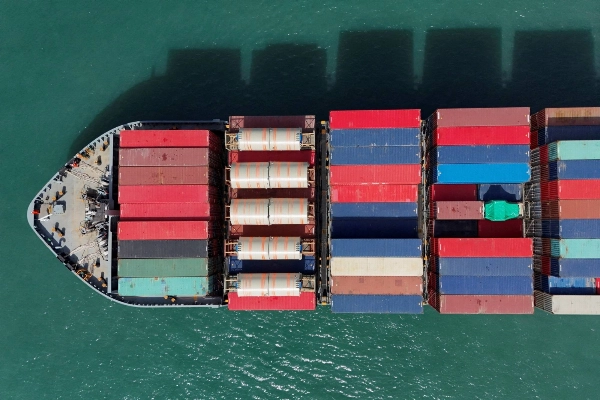
A cargo ship is seen at the Kwai Tsing Container Terminals in Hong Kong last April. China appears to be quietly contemplating an unconventional approach to rapidly boosting its naval power — transforming its vast commercial shipping fleet into an armada of makeshift warships. | REUTERS
China appears to be quietly contemplating an unconventional approach to rapidly boosting its naval power — transforming its vast commercial shipping fleet into an armada of makeshift warships.
Part of Beijing’s drive to integrate civilian resources with national defense requirements, the concept — if successfully implemented — could supplement the capabilities of what is already the world’s largest navy by ship numbers, potentially altering the balance of military power in the Indo-Pacific.
The aim, experts say, is to find new ways for commercial ships to support operations by the People’s Liberation Army (PLA).
This includes everything from amphibious assaults, to medical evacuation, logistics, reconnaissance and intelligence, as well as surface warfare and air defense — capabilities that, if successfully incorporated into commercial vessels, would redefine the criteria by which naval power is measured in the region.
“Like any country, China faces resource constraints and tradeoffs, so these kinds of ships could offer a more affordable means of achieving Beijing’s desired capability levels on a sufficient timeline,” said Brian Hart, deputy director at the Center for Strategic and International Studies think tank’s China Power Project.
“These ships may not provide all the capability China wants, but they may provide enough,” he added, arguing that the converted vessels would enable the Chinese military to rapidly scale up combat power without having to wait years for new, dedicated warships to enter service.
At the same time, this would compel U.S. and allied forces to focus valuable resources on identifying, tracking and targeting mobilized Chinese civilian ships, in addition to military vessels.
Catapults and missile launchers
A recent example of Beijing’s civil-military fusion approach is the Zhong Da 79 container ship, which was photographed late last month at Shanghai’s dual-use Hudong-Zhonghua shipyard equipped with a vast array of military systems.
The images show that the midsize cargo ship has been transformed into an apparent test-bed, fitted with apparent advanced radar and communication systems, decoy launchers, a close-in weapon system, containerized missile launchers and what seems to be a truck-mounted, electromagnetic catapult system for launching large, fixed-wing drones.
Since 2015, China has been building certain commercial ships to the military’s technical standards and design specifications, ensuring they can be used by the PLA in a crisis.
Part of the country's civil-military fusion drive, the shipbuilding standards include five categories of vessels: container, roll-on/roll-off, multipurpose, bulk carrier and break bulk ships.
Large Chinese naval or amphibious exercises also regularly include merchant ships used as helicopter or military vehicle carriers, particularly when training for a potential Taiwan invasion. The military has even begun experimenting with civilian landing craft tank (LCT) vessels in direct beach landing drills, according to Tom Shugart, an expert on the Chinese military at the Center for a New American Security think tank.
China has also modified commercial ships to experiment with different systems at sea such as ground artillery and directed-energy weapons, but seldom have the changes been as substantial as with the Zhong Da.
That said, it remains unclear whether the modular systems installed on this particular ship have ever been tested or if they are mere mockups.
This applies to the containerized vertical missile launch tubes — up to 48 large ones or about half as many as on a U.S. Arleigh Burke-class destroyer — and the truck-mounted, scalable and interlocking catapult system.
The latter is a technology that, if viable, could rapidly convert Chinese container ships into advanced drone carriers, and also be deployed on land to launch large drones from almost any location without the need for a runway.
While any country would prefer to have a fleet of advanced, dedicated warships, China’s experimentation with cargo vessels comes down to speed, affordability and comparative advantage, especially given that it builds more commercial tonnage than the rest of the world combined.
“No other country comes close to China in terms of quickly producing so many commercial hulls at scale,” Hart said.
Tapping into the commercial fleet could therefore be pivotal, he added, particularly in a protracted conflict, where success hinges not just on battlefield performance, but also on the ability to harness the necessary industrial might to sustain a war.
Every sailor on a warship is concerned about having limited munitions, said Eric Heginbotham, a security scholar at the Massachusetts Institute of Technology's Center for International Studies, pointing to the potential advantages modified cargo ships could bring to the battlefield by substantially increasing a navy’s firepower.
These advantages, along with the element of surprise, could also play a role in a Taiwan conflict.
“The PLA acknowledges that many of its preparations to launch an attack cannot be hidden from view unless they are hidden in plain sight,” said Ian Easton, an associate professor at the U.S. Naval War College's China Maritime Studies Institute. “That is where containerized missiles, rockets, and drone launchers come in.”
This, he added, is probably why the Chinese Navy has not built a large amphibious fleet.
“It instead prefers to hide the vast majority of its massive amphibious lift capacity under the camouflage of ‘civilian’ ships," Easton said.
“The last thing the PLA wants to do is fight an orthodox, conventional set-piece battle. That could be disastrous for them,” he added
Downsides and limitations
Analysts, however, don't believe the converted warships will become available for quite some time.
“The Chinese may be giving this a go, but it is unlikely that we will see this operationalized anytime in the near future,” Heginbotham said. The modifications, he added, would need to include many more features and advanced technology.
“Even for the simplest functions, mission planning would be required, and the ship would need to connect to the rest of the kill chain,” he said, referring to the process for planning and executing attacks.
Even then, the converted vessels would inevitably be at a disadvantage in a conflict, since they would lack key features of modern warships such as greater maneuverability, enhanced safety and low observability.
China’s ability to mass-produce advanced missile systems and drones, as well as to train enough personnel to operate the new systems would also be crucial factors limiting any deployment.
“The ship may or may not be a viable platform but the crew almost certainly would not be up to the task,” said Lonnie Henley, a former senior U.S. defense intelligence analyst on China.
“PLA commentators frequently bemoan the poor state of training as Beijing struggles to keep commercial ship crews trained on basic military tasks like sailing in convoy, military radio procedures and performing simple self-defense,” he said, adding that maintaining proficiency on operating the latest military tech would be “vastly more difficult.”
‘Without a doubt’
Despite the numerous technological and personnel challenges, experts agree that there is little doubt that China plans to use a large fleet of modified commercial vessels to assist military operations in any major conflict.
These ships could also be employed for covert or smaller scale operations that hinge on deception and surprise.
“This (push) is not a stopgap while the PLA develops greater capabilities to let it do without civilian support; rather, it’s a fundamental part of how Chinese leaders, both military and civilian, think about military conflict,” Henley said.

Subscribe to The Seafarer Times RSS Feeds

User login
Who's online
There are currently 0 users online.